

Now it's time to rock out to the backing track! Keep in mind the tempo increase at about 48 seconds in.
If you ever make a recording of yourself playing along with the backing track, be sure to share it with us in the forum so we can all hear your skills!
See you next time! Seanread more
Okay, here's where we apply everything we've discussed in this tutorial.
When I made this riff, I didn't think too hard about it at all. I basically just picked random notes and put them in random places. And hey, it didn't turn out too bad!
This is actually a really great way to write guitar riffs. Here's what I recommen...read more

In the beginning of this exercise, we'll immediately notice more of the fingerpicking that we discussed in the last lesson. In this case, we'll be plucking octave notes with our picking hand fingers.
In the last two bars, we'll close out the exercise with a couple bluesy riffs. Just a reminder, keep those bends in tune.
G...read more

The first riff is what I call my 'groove riff'. Now this is not your typical groove riff because we don't have much rhythmic variation. In this case, we have a tremelo picked riff that has an underlying half-time double kick part. The half-time feel in the drums gives it that groove feel.
Theoretically these riffs ar...read more

Hey everyone! This month, we're taking a look at triplets. Triplets (like any other tuplet) offer a very distinct rhythmic sound. The focus of this month's tutorial is taking our triplet runs to the next level; creating sub-divisions within a triplet phrase. I've devised six different approaches to a descending pattern in A...read more


Good Luck!read more
For this specific chapter, show and tell is by far easier than reading text. So for this chapter I urge you to just watch the video, and listen to what I have to say there.read more
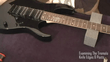
Checking the knife edges
As described in the video (and I do urge you to check this on the video), you can easily take off the tremolo to do maintenance, cleaning and such. If you have any tuning stability problems, you should always check the knife-edges to see if they are worn out, or not properly worn in. They should be...read more
String Change cont.
On a guitar with a locking nut, it is not necessary to use the string fastening techniques we've discussed before. You will have a locking top nut that will secure the strings. There are 2 main ways of fastening the strings:
1. Cut off the ball-end of the string, just before the double wind near the ba...read more
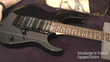
Tremolo Equipped Guitars For the final chapter, we will look at setup for a typical tremolo guitar, a Floyd Rose-type guitar such as an Ibanez. Some of the things have already been covered, such as cleaning the fret board and such.
In this first part, I will show you and easy way of taking the tremolo off the guitar while ...read more

Nut Height
Nut height is yet another thing we need to cover. The nut height affects playability and sound to a great extent, more so than intonation (that is more the contact points of the strings, as described earlier). If the nut is too high, it will be hard to chord (especially with heavy strings), and if it is too low,...read more
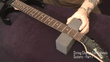
String change
In this first part of the video, I will just discuss and show you how to remove the strings, and things to consider.read more
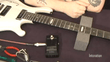
Ok, let’s say that your top nut is fine. Then let’s move on to intonating to rest of the neck.
The common way of intonating an electric guitar is to tune the open harmonic to pitch, and then check to see if the fretted note at the 12th fret is exactly in unison with that. Here you should use an accurate tuner, ...read more
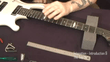
History and Background.
Okay then, time for the big one, which will contain much information besides the practical intonation adjustments. Intonation is probably the most misunderstood part of guitar set-up, and a huge part of the overall sound and playability of an instrument. What intonation in short can be said to be ab...read more
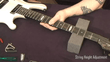
String height adjustment
So, once we’ve set the relief to a point that fits our string gauge and playing preferences, it’s time to adjust the string height. String height is also a matter of preference. Some like it high, some like it low. But, same thing here, to low a string height will cause buzzing, and dyn...read more
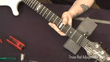
Truss Rod Adjustment - cont:
First of all we need to determine what our current relief is, and decide how or if we want to change that. The way to do this is either by using you eye-sight, or by measuring with a steel ruler or with so called “feeler gauges”, which are thing metal blades of different thicknesses...read more
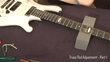
Truss Rod Adjustment
What is a truss-rod you might ask? The truss-rod is a metal bar inside the guitar neck, that flexes in or (or sometimes both) directions. This rod in place for two reasons: 1. To stabilize the neck and stop it from warping. 2. To be able to bend the neck to the relief (bow) that you desire.
With that ...read more

Fret Board Maintenance
When changing strings, I recommend you change them one at a time, unless you feel the need to clean your fret board, oil it in, or polish your frets. This will keep the neck in constant tension, and won’t de-stabilize it momentarily.
If you however, have a dirty/grimy fret board, or need to po...read more
Locking Tuners cont.:
1. Thread the string through the bridge like before. Nothing out of the ordinary here.
2. Thread the string through the hole in the locking tuning peg. Pull the string tight and hold it taut on the other side of the locking post.
3. There are two ways from here, either you hold the string taut, and ...read more
String Change for locking tuners
In this first part, you will be presented with the workings on the locking tuner, and how to un-fasten strings from them.
There are mainly two ways of doing this:
1. Start to unwind the string from the tuner, as the tuner and string comes in line with the fret board, just keep on turning ...read more
String change for vintage tuners
The first part with fastening the string to the bridge is the same. Then follow this procedure (And check the video!):
1. Turn the tuning head, so that the slot in the peg head is in line with the fret board. In a vintage tuner, you will also see a hole drilled in the centre on the peg hea...read more

In this last part, I discuss outlining scales. What I mean by this is that just as a voicing or chord has a certain overall quality and texture, an entire scale has a quality of its own. That is, if you run scales up and down, that is one thing, you can still learn to recognize the scale by ear thanks to the scale degrees. ...read more
Save Lesson
Complete Lesson
Minor Voicings - Part 2 & Changing Scale Roots
Chords
Fusion
Intermediate
So, here I’ve derived my voicings from the same E minor scale, but started out with an Esus4 voicing. I also touch upon another topic here, the topic of key change by altering root. Let’s say you play these voicings over that E-bass note, and play the E minor scale over that. Your scale will sound like an Eminor...read more
Time for Minor! In this part we’re looking at the E minor scale. Also, I have chosen other voicings. I found a voicing I really liked, and ran with that. As you will hear this leads to more “fusionesque” tones. The concept is the same though, this time I use the low E string as a continuous bass-drone. So,...read more
To begin with, let’s review what a chord is. A chord is a group of notes derived from a given scale, put together in a cluster. For instance, let’s take the key of Emajor (as presented in the scale charts below). The tonic (I-degree) of E major would be the root, major third and fifth degree of the major scale, ...read more