
Chord Progressions
Many times, people put together chord progressions based off of how they sound together. Some people rely on intuition. Others base their progressions off of songs that they already know. The latter is what I tend to gravitate towards a lot of the time. Many professional musicians who work as songwriters understand the basics of music theory and how chord progressions are created. This tutorial will examine how and why some progressions work, and will give a future songwriter the tools they need to create any song they want. A chord progression usually follows a series of sections within the chord progression itself. These sections are: stability, contrast and tension. The stable section is made up of a chord that defines the key of the song. The contrasting section is where either one or more chords will draw you away from the tonic focal point of the song. The tension sections does just what it says: it creates tension that will return the listener back to the beginning chord(s) of the song. You can repeat this as many times as you want within your song. The most basic form of this is the I-IV-V progression, with the I chord being in the Stability section, the Iv chord being in the Contrasting section, and the V chord being in the Tension section, which returns the listener back to the I chord. Shown here is an example of a I,IV,V progression in the key of C major: (Ex.#1): C(I) / F(IV) / G7(V) / C(I) The I,IV,V progression also works the same way with Minor keys: (Ex.#2): Em(I) / Am(IV) / B7(V) Tune into part 2 where we will be going over root movement.
8 Lessons
- 1 1:55 Backing track · 2m Chord Progressions - Introduction Many times, people put together chord progressions based off of how they sound together. Some people rely on intuition. Others base their progressions off of songs that they already know. The latter is what I...
- 2 1:15 Backing track · 1m Chord Progressions - Root Movement The main propulsion for harmonic movement in your chord progression will usually occur between the bass notes which are either a perfect 4th or perfect 5th apart. Here is a version of a I, IV, V again showing...
- 3 1:01 Backing track · 1m Chord Progressions - Common Tone Substitution Hello and welcome to part 3 of this exciting tutorial on Chord Progressions, where we will be talking about Common Tone Substitution. *cue dramatic intro music* Any harmonized scale contains notes that are...
- 4 2:04 Backing track · 2m Chord Progressions - Harmonic Rhythm "...and now back to 'Chord Progressions' where we last left them..." Putting chords together isn't really enough. You also need some good harmonic rhythm, which is how long a chord will last within your...
- 5 1:40 Backing track · 2m Chord Progressions - Secondary Dominants Another technique involves inserting dominant chords before other chords to create a stronger sense of movement to the next chord. The root of a secondary dominant is going to be a perfect 5th away from the...
- 6 1:13 Backing track · 1m Chord Progressions - Diminished Chords Now, in the previous lesson, we learned that both V chords and vii chords can function as Dominant chords, but when using diminished chords, these can be put in the place of a V chord and that diminished chord...
- 7 2:00 Backing track · 2m Chord Progressions - Tri-Tone Substitution Now, one thing we have to understand is what exactly the tri-tone substitution is. It's basically where we substitute a dominant chord that is a tri-tone away (#4/b5) from the root of the original dominant...
- 8 1:07 Backing track · 1m Chord Progressions - Changing Chord Quality This is the final installment of this tutorial, and this one is going to be a very simple way of enhancing your chord progressions, which is changing the quality of any chord, whenever you like. Experiment...
More like this
 All About Harmonics
Richard Lundmark
Greetings Guitar Slingers! Welcome to yet another (long) tutorial from yours truly. This time we will dive deep into the wonderful world of Harmonics! The theory, concepts and practice of harmonics in all its...
 Exploring the Sixth
Martin Miller
Welcome to another tutorial! This time we’ll be dealing with an interval called the sixth. Just to give you a brief theoretic explanation: an interval is the distance of the pitches of two notes. The sixth...
 Soldering
Lucas Fowler
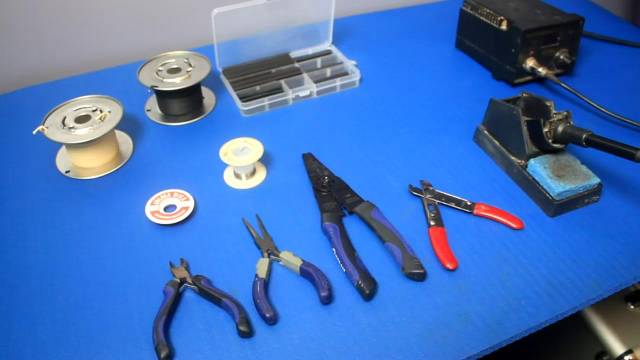
Hey guys! This month we're going to talk about basic soldering for electric guitar players. This will be a really simple crash course to get you into how to do easy things like repairing jacks, cables...
 What are Chords? - The Harmonized Major Scale
Mike Edwin
Chords! A chord is a series of notes played together. There are hundreds even thousands of chords available to play on the guitar. Once you begin to understand the essentials of building chords, and...
 Ascendance of the Spheres - Solo Study
Rick Graham
Hey dudes, wassup! Thanks for checking in on this tutorial. What we're going to be doing is looking at the solo to my track 'Ascendance of the Spheres' taken from my 2005 ep, Re-Invention. Let's take a look at...
 Setting Yourself Apart - Sight Reading
Jody Mac
Hey Guys! This tutorial is an introduction to sight reading. It assumes that you are already familiar with standard notation on the treble clef. If you aren't ready to dive into it yet, be sure to check out...