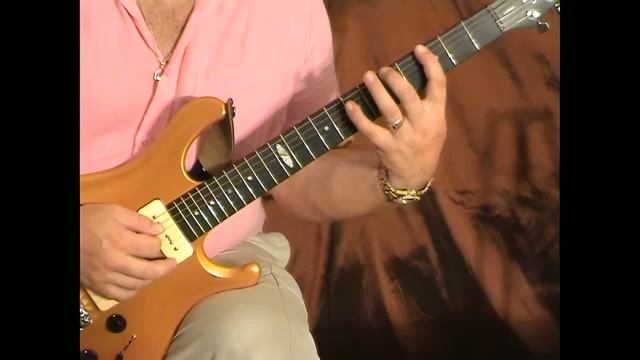

Brian May
“Bohemian Rhapsody” Queen, 1975
The solo is in E flat major, mixing the full major scale with major pentatonic licks high up the neck.
E♭ major · 15th fret
Photo: Andreas Streng, CC BY-SA 3.0, cropped

D Major
Do, re, mi, fa, sol, la, ti, do. The major scale is the one you already know by ear, and it's the yardstick for the rest of music theory. Learn it on the neck and every other scale, chord and mode gets easier to understand.
The major scale has seven notes: the root, 2nd, 3rd, 4th, 5th, 6th and 7th. In G that's G, A, B, C, D, E and F sharp, and in C it's just the white keys on a piano. The half steps fall between the 3rd and the 4th and between the 7th and the root, and that pattern is what gives it its bright, settled sound.
Musicians describe every other scale against it: a flat 3rd or a missing 4th is always counted from the major scale. Start the same seven notes from a different note and you get the modes, so G major started from E is E natural minor. On guitar, learn the shape around the root on the low E string first, near the 3rd fret in G, then link it to the shapes above it.
Its formula is 1 2 3 4 5 6 7: root, 2nd, 3rd, 4th, 5th, 6th, 7th. Counted from one note to the next, that's a whole step, whole step, half step, whole step, whole step, whole step, half step.
From stadium anthems to ballads, these melodies come straight from the major scale. Each card shows the key of the song and where that box sits on the neck, so you can find it on your own guitar.
Big, bright lines you can sing along to. These players use the whole major scale, not just the pentatonic box.
“Bohemian Rhapsody” Queen, 1975
The solo is in E flat major, mixing the full major scale with major pentatonic licks high up the neck.
E♭ major · 15th fret
Photo: Andreas Streng, CC BY-SA 3.0, cropped

“Sweet Child O' Mine” Guns N' Roses, 1987
The intro riff and the first two solos come from the G major scale. The band tuned down a half step, so the record sounds a half step lower.
G major · 12th fret
Photo: Kreepin Deth, CC BY-SA 4.0, cropped
Slow, singing melodies where every note of the scale counts, from a love song to a guitar instrumental.

“Wonderful Tonight” Solo artist, 1977
The song is in G major, and the famous intro lick picks out notes of the G major scale with slow, singing bends.
G major · 7th fret
Photo: Chris Hakkens, CC BY-SA 2.0, cropped

“Always With Me, Always With You” Solo artist, 1987
The main melody is built on B major, with a darker B minor section in the middle before it comes home to B major.
B major · 4th fret
Photo: Shape Prior, CC BY-SA 3.0, cropped
Here are all five boxes in G. Position 1 starts on the root on the low E string, and each next box starts a little further up the neck until the pattern repeats an octave higher. Press Show positions in the chart above to light each one up and hear it.
Same shapes, different starting fret. Find your key, then start position 1 at that fret on the low E string.
| Key | Notes | Position 1 starts at |
|---|---|---|
| A major | A B C♯ D E F♯ G♯ | 5th fret |
| B♭ major | B♭ C D E♭ F G A | 6th fret |
| B major | B C♯ D♯ E F♯ G♯ A♯ | 7th fret |
| C major | C D E F G A B | 8th fret |
| D♭ major | D♭ E♭ F G♭ A♭ B♭ C | 9th fret |
| D major | D E F♯ G A B C♯ | 10th fret |
| E♭ major | E♭ F G A♭ B♭ C D | 11th fret |
| E major | E F♯ G♯ A B C♯ D♯ | Open strings (or the 12th fret) |
| F major | F G A B♭ C D E | 1st fret |
| F♯ major | F♯ G♯ A♯ B C♯ D♯ E♯ | 2nd fret |
| G major | G A B C D E F♯ | 3rd fret |
| A♭ major | A♭ B♭ C D♭ E♭ F G | 4th fret |
Stack every other note of D major and you get these seven chords. Any of them sounds at home under a major melody:
And the chords to solo over with it:
All of them are in the guitar scales chart, in every key.
See it played and try it yourself with these video lessons from the Infinite Guitar library:
G, A, B, C, D, E and F sharp. The table above lists the notes of the major scale in all 12 keys.
Whole, whole, half, whole, whole, whole, half. Written as scale degrees it's 1 2 3 4 5 6 7, and every major key follows the same pattern of steps from its root.
Yes. Ionian is the name for the major scale when it's listed with the other modes. G Ionian and G major are the same seven notes.
Its half steps land exactly where the natural notes have them, E to F and B to C. Every other major key needs at least one sharp or flat to keep the same pattern of steps.
Count up to the 6th note of the major scale. The relative minor of G is E minor and the relative minor of C is A minor. They share the same notes, so the same shapes work for both.
We use them to run the site, see how it's used, and help with marketing. Change your mind anytime. Privacy policy