
Jerry Garcia
“Franklin's Tower” Grateful Dead, 1975
The song is a two-bar loop of A, G and D in A Mixolydian, the kind of groove Jerry loved to stretch out on.
A Mixolydian · 5th fret
Photo: Carl Lender, CC BY 2.0, cropped

B Mixolydian
Mixolydian is the major scale with a flat 7th, and it's all over rock and roll. It's happy with a little blues in it, the sound of a dominant 7th chord, and it's what jam band guitarists reach for when the groove sits on one chord.
The Mixolydian mode is the fifth mode of the major scale. Play the notes of D major from A to A and you get A Mixolydian: A, B, C#, D, E, F# and G. Compared with the A major scale, only the 7th changes. Mixolydian has a flat 7th (G) where major has a natural 7th (G#), and that note gives it its laid-back, bluesy edge.
Mixolydian fits over dominant 7th chords like A7, and over rock progressions that use the flat 7 chord, like A, G and D. On guitar, a lot of players start from the major pentatonic and add the 4th and the flat 7th, which gets you the whole mode.
Its formula is 1 2 3 4 5 6 b7: root, 2nd, 3rd, 4th, 5th, 6th, flat 7th. Counted from one note to the next, that's a whole step, whole step, half step, whole step, whole step, half step, whole step.
Major with a flat 7th: the sound of jam bands, Southern rock and loose, bluesy solos. Each card shows the key of the song and where that box sits on the neck, so you can find it on your own guitar.
One or two chords, a rolling groove and solos that keep going. Mixolydian is home base for this kind of jamming.
“Franklin's Tower” Grateful Dead, 1975
The song is a two-bar loop of A, G and D in A Mixolydian, the kind of groove Jerry loved to stretch out on.
A Mixolydian · 5th fret
Photo: Carl Lender, CC BY 2.0, cropped

Bright riffs and solos with a bluesy flat 7th, from '70s FM radio to '90s alt rock.

“Reelin' in the Years” Steely Dan, 1972
Randall's guest solo is one of the best-known Mixolydian solos in classic rock, built on A Mixolydian.
A Mixolydian · 5th fret
Photo: ArtBrom from Seattle, CC BY-SA 2.0, cropped

“Interstate Love Song” Stone Temple Pilots, 1994
The churning main riff is built on E Mixolydian, one of the best-known Mixolydian riffs of the '90s.
E Mixolydian · open position
Photo: U.S. Army Garrison Hawaii, public domain
Here are all five boxes in A. Position 1 starts on the root on the low E string, and each next box starts a little further up the neck until the pattern repeats an octave higher. Press Show positions in the chart above to light each one up and hear it.
Same shapes, different starting fret. Find your key, then start position 1 at that fret on the low E string.
| Key | Notes | Position 1 starts at |
|---|---|---|
| A Mixolydian | A B C♯ D E F♯ G | 5th fret |
| B♭ Mixolydian | B♭ C D E♭ F G A♭ | 6th fret |
| B Mixolydian | B C♯ D♯ E F♯ G♯ A | 7th fret |
| C Mixolydian | C D E F G A B♭ | 8th fret |
| C♯ Mixolydian | C♯ D♯ E♯ F♯ G♯ A♯ B | 9th fret |
| D Mixolydian | D E F♯ G A B C | 10th fret |
| E♭ Mixolydian | E♭ F G A♭ B♭ C D♭ | 11th fret |
| E Mixolydian | E F♯ G♯ A B C♯ D | Open strings (or the 12th fret) |
| F Mixolydian | F G A B♭ C D E♭ | 1st fret |
| F♯ Mixolydian | F♯ G♯ A♯ B C♯ D♯ E | 2nd fret |
| G Mixolydian | G A B C D E F | 3rd fret |
| A♭ Mixolydian | A♭ B♭ C D♭ E♭ F G♭ | 4th fret |
Stack every other note of B Mixolydian and you get these seven chords. Any of them sounds at home under a Mixolydian melody:
And the chords to solo over with it:
All of them are in the guitar scales chart, in every key.
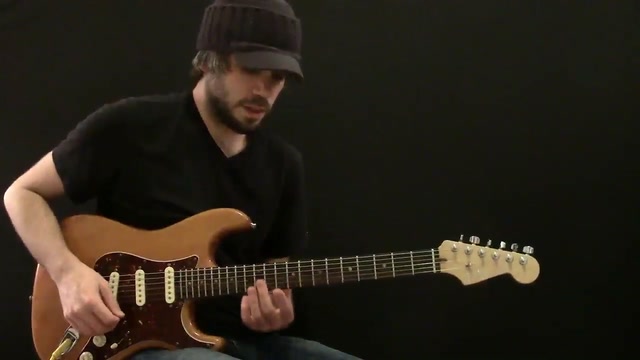
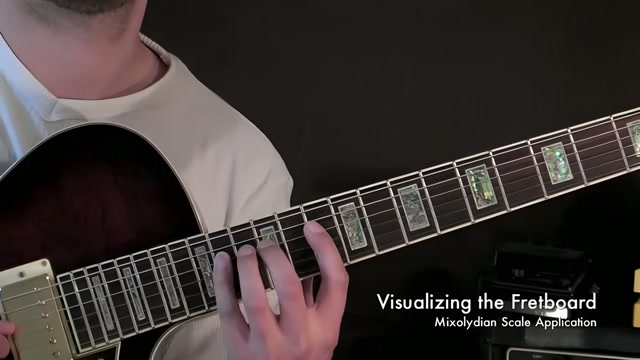
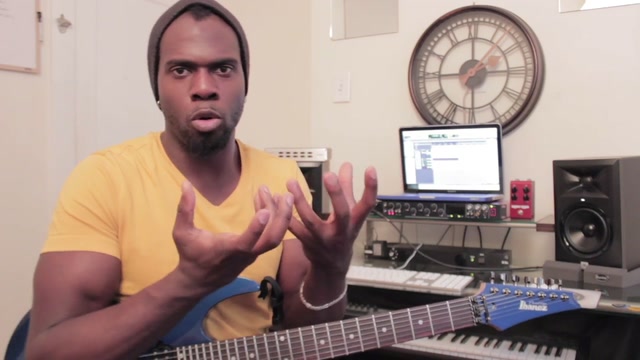
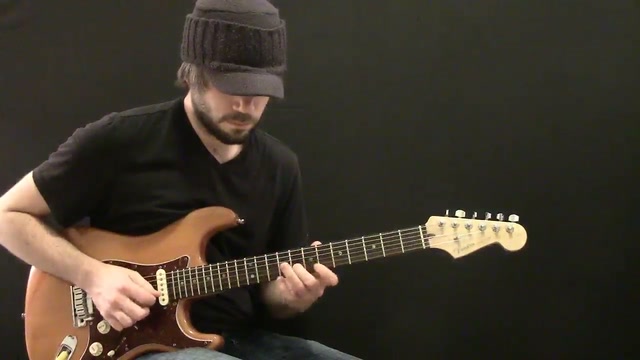
See it played and try it yourself with these video lessons from the Infinite Guitar library:
A, B, C#, D, E, F# and G. Those are the notes of D major, started from A. The table above lists Mixolydian in all 12 keys.
Root, 2nd, 3rd, 4th, 5th, 6th and flat 7th (1 2 3 4 5 6 b7). Counted in steps from the root, that's a whole step, whole step, half step, whole step, whole step, half step and a whole step back to the root.
Just the 7th. The major scale has a natural 7th and Mixolydian has a flat 7th. In A, Mixolydian has G where A major has G#. That flat 7th is the same note that turns an A chord into A7.
Dominant 7th chords like A7 or E9, and rock progressions that use the flat 7 chord, like A to G or D to C. Both point straight at Mixolydian.
Yes. Over a dominant 7th chord it covers every chord tone, so it's a great way to add sweet, major sounds to a blues solo. Many players switch between the minor pentatonic and Mixolydian in the same solo.
We use them to run the site, see how it's used, and help with marketing. Change your mind anytime. Privacy policy