
Al Joseph
Guitar Instructor
Select Instructor
Al's Music
About Al
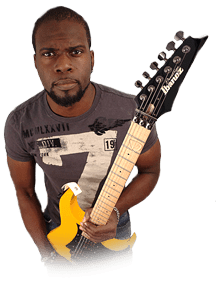
Al Joseph was born in 1987 in Highland Park, IL and was raised in Scranton, PA from 1996 on. He started playing drums when he was 10 years old. About a year or so later, he left the drums to pursue his growing passion for the guitar.
He later went on to study economics and participated in various college sports at Penn State University in 2006. He later decided to pursue music as his primary career and later auditioned at Berklee College of Music in 2012. Al Joseph is now a proud Alumni of Berklee College of Music.
He is also a proud member of a Progressive Metal band called “The Great Gamble”. Be sure to check out their debut album released in 2012 called “Book 1”.
Al has a debut solo album titled “Out In The Open”. Check it out on iTunes! You can also find some great backing track packages he created at Jam Track Central.
“Thanks for stopping by and Be Blessed!”
AJ
Al's Lessons
Display
Type
Sort
This tutorial is special. I'm going back to the basics with picking technique and this time I'm giving you an inside look into my own routine and how I've single-handedly taken every techniq...
In this video I spill all the secrets. We're going to cover my deep thoughts on how to abtain the ultimate essense of: 1. Musical Awareness2. Time Feel3. Touch - Note Duration4. Relaxation ...
This exercise should be relaxing and fun. You should also be able to monitor your progress every step of the way. This is not to say it WILL be easy for you at first. But rest assured that i...
This exercise should also be simply relaxing and fun. Monitor your progress ever step of the way. This time we are adding another string to demonstrate legato, or playing from note to note a...
Rinse and repeat until you sound like me. Then take these principles into your practice routines and implement them into your own lines. It's super important. I'm literally teaching you to n...

PICKING WORKOUT FOR BEGINNERS Remember that the goal here is to fully capture the essense of: 1. Musical Awareness2. Time Feel3. Touch - Note Duration4. Relaxation Enjoy :)

PICKING WORKOUT FOR BEGINNERS Remember that the goal here is to fully capture the essense of: 1. Musical Awareness2. Time Feel3. Touch - Note Duration4. Relaxation Enjoy :)
In this tutorial, we'll learn how to construct triads using the 4th scale degree. The key here is E Major Lydian. E - F# - G# - A# - B - C# - D# - E. All we have to do from here is b...
The key here is E Major Lydian. E - F# - G# - A# - B - C# - D# - E. Inversions come into play when you want to replace the root with another note within the chord. So say we have the triad ...
The key here is E Major Lydian. E - F# - G# - A# - B - C# - D# - E. Here we have our root position triads in diatonic order starting from E-A#-B. Simply build a 4th triad off of each scale ...
The key here is E Major Lydian. E - F# - G# - A# - B - C# - D# - E. Here we have our 1st inversion triads in diatonic order starting from A#-B-E. Simply build a 4th triad off of each scale ...
The key here is E Major Lydian. E - F# - G# - A# - B - C# - D# - E. Here we have our 2nd inversion triads in diatonic order starting from B-E-A#. Simply build a 4th triad off of each scale ...
When all is said and done...use your ear. Visualizing the fretboard is an eye and ear endeavour. So when it comes to comping in a real life setting, it should be understood that playing off ...

Here is the backing with a solo example. Next page has the backing by itself.

Today we're going to use just a handful of notes to understand modes. We're going to explore the Major 9th, Major 3rd, and Minor 7th scales degrees to better understand E Mixolydian! Let's ...
Understand that for every mode you explore there are chord tones and other intervals that make that mode sound the way it does. All other tones are used as "passing tones". Passing tones ar...
The major 3rd is a chord tone and can be used by itself. Keep in mind that it needs to reseolve to the tinic or root note by the end of any given phrase. You'll also notice that you can emb...
The 9th scale degree is actually the "2nd" scale degree yet and octave up past the 8th(octave) scale degree making it a 9th from the root. Notice how the 9th too likes to resolve to the ton...
The minor 7th likes to resolve up to the root. Once again you can prolong your phrase and move through the different chord tones before ending the phrase properly. Notice at this poin...
Notice at this point a scale acts just like that. It's balanced perfectly. The farther out say 9th or 6th degree, the weaker the movement and most times feels the need to hit say the 3rd or ...

Here's another round of licks I'm visualizing using shapes as well as using intervallic pivot points (by ear) to gauge my position when phrasing my lines. Lick #1 is based on another 7th ar...