

Solving Mode Mysteries
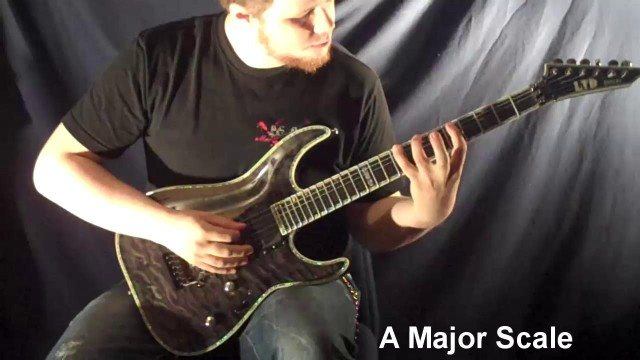
Let's examine modes in a "meat and potatoes" kind of way; a way that enables you to use the box shapes you already know to produce different musical textures that perhaps were unattainable with a one-track "major or minor" mind-set. Let's stay away from scale formula and other such complexities and examine modes for what they really are, and how they can flavour our soloing. We've probably all heard the "modes are just the major scale starting from a different note" definition before, but if you're anything like myself, felt as if such a definition deemed modes meaningless because, well... who cares what order you play the notes in as long as they're in the "right key"? So the basic outcome of this month's lesson is to use what we already know (major/minor scales) to develop three major and three minor modes from ONE given position (A major/A Minor). We'll be excluding the 7th mode, Locrian, for the time being. Minor Modes The three minor modes are Aeolian, Dorian and Phrygian. First thing's first, let's have a look at three minor scales, starting with A minor, then E minor and then on to D minor. Get familiar with them and feel free to noodle for a while and explore the fretboard. All set? So the purpose of knowing these minor scales (up and down the fretboard) is that when played over an A minor chord, we hear each of the three minor modes with each scale change. Playing an A Minor Scale over an A Minor Chord will produce Aeolian Playing an E Minor Scale over an A Minor Chord will produce Dorian Playing a D Minor Scale over an A Minor Chord will produce Phrygian So let's get practical! After playing through these three scales, take a look at the root positions of each scale and you'll notice it's very simplistic in achieving these modal sounds by basically shifting the "root". Play a minor scale from the root of the chord and you get Aeolian. Play a minor scale from the fifth of the root of the chord and you get Dorian (one string down, two frets up) Play a minor scale from the fourth of the root of the chord and you get Phrygian (down one string, same fret) This works over ANY minor chord. For instance, to hear the Dorian sound over a Gm chord, begin the minor scale on one string beneath the root note and two frets up. What do you get? The D minor scale... The Dorian sound. The goal, however, is to confine these scales to seven notes which begin on A and end on A. (The purpose of being able to do so will become very apparent when soloing over chords with different harmonic make-up which warrent certain modal changes which we'll get into in upcoming lessons). So in the second line, this is what we're demonstrating: An A Minor Scale, starting from A (A B C D E F G A) An E Minor Scale, starting from A (A B C D E F# G A) A D Minor Scale, starting from A (A Bb C D E F G A) Playing through these patterns from one root note will really highlight the characteristic tonality behind each mode. Let's play through each one over an A Minor chord backing track. I also recommend playing through each mode, one after another, in a repeated fashion for as long as it takes for transitioning to feel natural. Got all that? Pretty simple, huh? Let's take a look at the three major modes.
2 Lessons

More like this
 Visualizing Pentatonics
Tom Quayle
Hi there guys! Welcome to this tutorial on visualizing pentatonic scales for guitar. This tutorial aims to help you break out of the rut that the typical box pattern approach to learning pentatonics can...
 Visualizing the Fretboard - Major Scales and Modes
Tom Quayle
Hi there guys! Welcome to this tutorial on how to Visualize the Fretboard. This tutorial is going to deal with learning major scales and their modes and how to visualize them on the guitar. I'm sure in your...
 Using Melodic Minor Scales
Tom Quayle
Hi Guys! Welcome to this tutorial on using Melodic Minor Scales. In this tutorial we'll be learning how to use melodic minor scales in conjunction with the major scales we already know in a harmonic context...
 Minor 6th Pentatonics
Tom Quayle
Hi there guitar lovers! This months tutorial is on Minor 6th pentatonic scales. What an earth are those you may ask? A minor 6th pentatonic is a hybrid pentatonic scale built from a Dorian or Melodic Minor...
 Advanced Patterns and Sequences
Rick Graham
Alrighty then! Let's get cracking on the first sequence. The whole sequence is based around the tonal centre of A dorian and while it is mainly diatonic, there are some additional passing notes present which...
 Creative Scales - Pentatonic Hybrid Scale
Rick Graham
Hey everyone and welcome to this Creative Scales tutorial! We are going to get creative with the Pentatonic scale by creating a hybrid of two scales: A minor Pentatonic and E minor Pentatonic What we are going...