

Scale Chord Voicings
Greetings Guitar slingers! In this tutorial we will look at the concept of Scale Chords. The main focus of this tutorial is not chord theory, scale theory, or any theory in general. Of course it always helps if you do have some theoretical knowledge when working with chord voicings. However, the object of this tutorial is to open your ears and mind to a different approach to creating voicings within a given key (or scale). Instead of playing the standard chords buildt on the 7 scale degrees, we will find a voicing that we like and then just treat all voicings as belonging to a scalar sound rather than as individual chords. The idea of viewing chords not as individual blocks, but rather as members of a scale, where any chord are just any given number of notes of the scale brought forward is not new. In fact, the first time I was presented to this train of thought was through the chord voicings of Holdsworth. You can of course, and (depending on your theoretical provess) should analyze the voicings contained herein, and your own as well. But, the main focus is as I said ear-related, not theoretical. So, grab your axe and head on to the first part!
6 Lessons
-
1
0:53
Lesson · 1m Scale Chord Voicings - Introduction
Greetings Guitar slingers! In this tutorial we will look at the concept of Scale Chords. The main focus of this tutorial is not chord theory, scale theory, or any theory in general. Of course it always helps...
-
2
 6:03
Lesson · 6m Major Voicings - Part 1
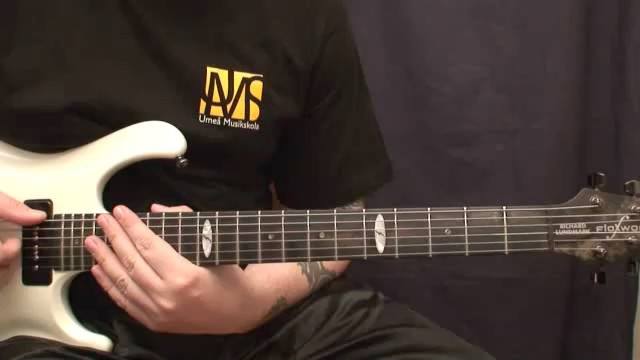
To begin with, let’s review what a chord is. A chord is a group of notes derived from a given scale, put together in a cluster. For instance, let’s take the key of Emajor (as presented in the scale charts...
-
3
 4:30
Lesson · 5m Major Voicings - Part 2
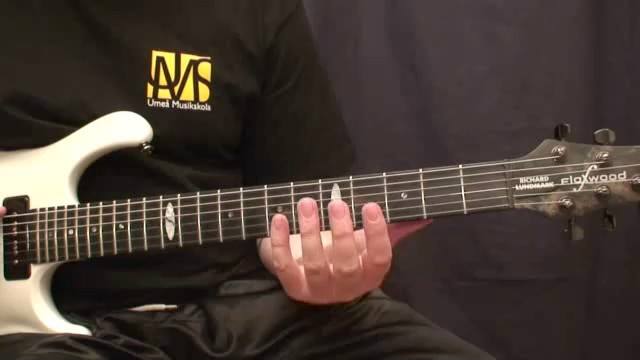
OK, in this second part of major voicings, we’re looking at D major. Same idea; map out the scale across the fret board, and find a voicing you like. The difference here is that I have incorporated the open...
-
4
 4:53
Lesson · 5m Minor Voicings - Part 1
Time for Minor! In this part we’re looking at the E minor scale. Also, I have chosen other voicings. I found a voicing I really liked, and ran with that. As you will hear this leads to more “fusionesque”...
-
5
 5:50
Lesson · 6m Minor Voicings - Part 2 & Changing Scale Roots
So, here I’ve derived my voicings from the same E minor scale, but started out with an Esus4 voicing. I also touch upon another topic here, the topic of key change by altering root. Let’s say you play...
-
6
 7:25
Lesson · 7m Outlining Scales & Creating Outside Harmony
In this last part, I discuss outlining scales. What I mean by this is that just as a voicing or chord has a certain overall quality and texture, an entire scale has a quality of its own. That is, if you run...
More like this
 Playing Over Changes
Tom Quayle
Hi there guys! Welcome to this tutorial on 'Playing Over Changes'. This is the idea of playing or improvising over a series of chords that change key every bar or other bar. We aren't going to be dealing with...
 Visualizing Pentatonics
Tom Quayle
Hi there guys! Welcome to this tutorial on visualizing pentatonic scales for guitar. This tutorial aims to help you break out of the rut that the typical box pattern approach to learning pentatonics can...
 Modern Legato Application
Tom Quayle
Hi there guys and welcome to this tutorial on Legato and Hybrid picking that I've entitled Modern Legato Application/Approach. In this lesson I'm introducing you to 5 examples of phrases or lines that I often...
 Playing Outside
Tom Quayle
Hi Guys and Gals! Welcome to this months tutorial which is all based on 'outside' playing. Now I'm not suggesting that you all find a nice field somewhere and play in the fresh air. Rather the way in which...
 Playing Over Changes Pt 2
Tom Quayle
Hi there and welcome to part 2 of 'Playing over Changes'. This time we'll be dealing with melodic minor chords and their associated scale choices and also with motivic development over changes. For the purpose...
 Using Melodic Minor Scales
Tom Quayle
Hi Guys! Welcome to this tutorial on using Melodic Minor Scales. In this tutorial we'll be learning how to use melodic minor scales in conjunction with the major scales we already know in a harmonic context...