

Using Melodic Minor Scales
Hi Guys! Welcome to this tutorial on using Melodic Minor Scales. In this tutorial we'll be learning how to use melodic minor scales in conjunction with the major scales we already know in a harmonic context. By the end of these lessons you'll have a good understanding of how some of the ways in which we can use melodic minor scales and their associated chords to enhance and develop chord progressions created in major keys. I'll provide you with some example chord progressions and the chords available to you and provide you with three backing tracks to practice improvising, utilising these scales. First of all though, how do we play a melodic minor scale and what is it? Well, very simply, a melodic minor scale is a major scale where the 3rd note has been flattened by one fret (in other words moved one fret down the neck.) For example, below in the TAB is the scale C major containing the notes C,D,E,F,G,A and B. Have a look at the C melodic minor scale next to it and you'll see that the note E has been flattened to Eb giving us the notes C,D,Eb,F,G,A and B. So, a melodic minor scale is a major scale with a flattened 3rd. Before moving on, get the sound of this scale into your mind. The purpose of this tutorial is not to teach you this scale all over the neck. A separate visualisation tutorial would be required for that. For the time being that work is up to you guys. Today we'll be looking at how the scale functions in a harmonic context in modern music. A very important side note! - If you've studied any classical harmony you may know that in this style of music there are two forms of a melodic minor scale, an ascending one and a descending one. In modern music we do not use both, only the ascending one which is the form shown below. Move onto lesson two where we'll start to look at the chords contained in this melodic minor scale.
11 Lessons
-
1
1:51
Lesson · 2m Melodic Minor Scales - Introduction
Hi Guys! Welcome to this tutorial on using Melodic Minor Scales. In this tutorial we'll be learning how to use melodic minor scales in conjunction with the major scales we already know in a harmonic context...
Tab
-
2
 4:06
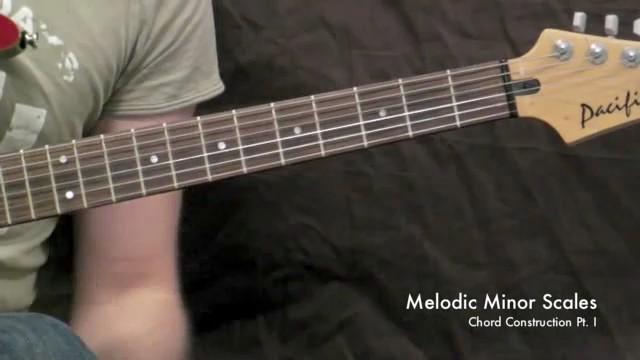
Lesson · 4m Melodic Minor Scales - Chord Construction Pt. I
Just as when we build the seven chords from a major scale, we can build seven chords from our melodic minor scale. The first thing I want to say is don't worry if you've never studied chord construction at...
Tab
-
3
 3:03
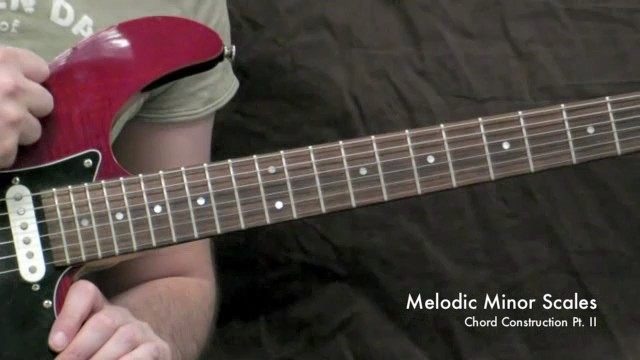
Lesson · 3m Melodic Minor Scales - Chord Construction Pt. II
Remember that I'm playing these chords in 4ths tuning but the TAB is in standard so my shapes look a little different. Chord V is built from the note G and is called, G7#5 or G seven sharp five. Two voicings...
Tab
-
4
 4:41
Lesson · 5m Melodic Minor Scales - How do we use them?
Okay! So now we have our 7 chords for the key of C melodic minor. But how do we use them? Well first it's important to understand the fundamental difference between major scale harmony and melodic minor scale...
-
5
 5:22
Lesson · 5m Melodic Minor Scales - Chords In Use
Here we go! For the first set of examples I'll be using the key of Cmajor. This gives us the following chords and all their variations, C major, D minor, E Minor, F major, G major, A minor and B diminished...
-
6
 2:40
Lesson · 3m Melodic Minor Scales - Example Improvisation 1
In this improvisation, I'm soloing over just two chords. Remember, it's very common to combine a major scale with the melodic minor scale built from it's 4th degree. The first chord is Eb Major and the second...
-
7
 4:43
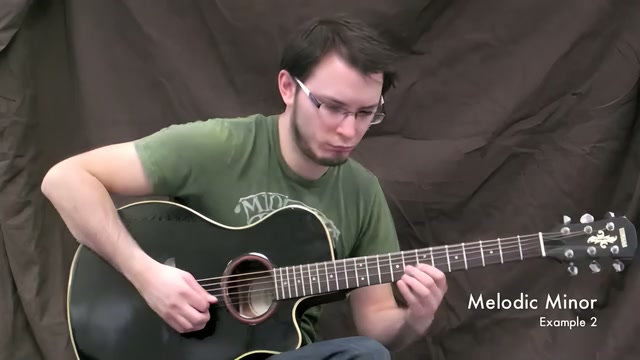
Lesson · 5m Melodic Minor Scales - Example Improvisation 2
This improvisation combines chords from a few different scales but is primarily in the key of Cm (the relative minor of Eb major). It features a descending bass line progression with some really nice harmony...
Tab
-
8
 4:20
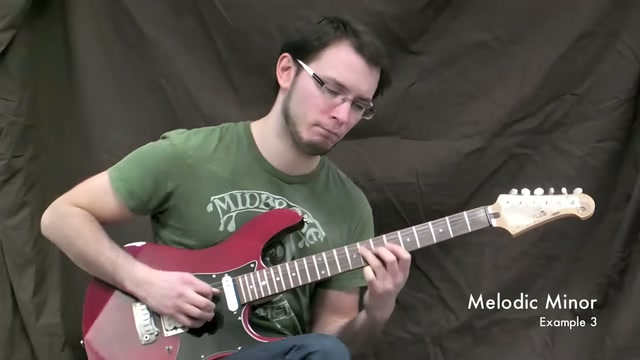
Lesson · 4m Melodic Minor Scales - Example Improvisation 3
This final example is a bit more up tempo to give you a bit more of a soloing challenge! Again we're in the key of Eb major but we have a new melodic minor source this time. We start with two bars of Eb major...
Tab
- 9 2:56 Backing track · 3m Melodic Minor Scales - Backing Track 1 Just two chords! Ebmajor followed by Abm6. Use Eb major or Eb lydian for the Eb chord and Ab melodic minor for the Ab chord. Good luck!
- 10 5:21 Backing track · 5m Melodic Minor Scales - Backing Track 2 Tab
- 11 4:29 Backing track · 4m Melodic Minor Scales - Backing Track 3 Tab
More like this
 Playing Over Changes
Tom Quayle
Hi there guys! Welcome to this tutorial on 'Playing Over Changes'. This is the idea of playing or improvising over a series of chords that change key every bar or other bar. We aren't going to be dealing with...
 Visualizing Pentatonics
Tom Quayle
Hi there guys! Welcome to this tutorial on visualizing pentatonic scales for guitar. This tutorial aims to help you break out of the rut that the typical box pattern approach to learning pentatonics can...
 Modern Legato Application
Tom Quayle
Hi there guys and welcome to this tutorial on Legato and Hybrid picking that I've entitled Modern Legato Application/Approach. In this lesson I'm introducing you to 5 examples of phrases or lines that I often...
 Playing Outside
Tom Quayle
Hi Guys and Gals! Welcome to this months tutorial which is all based on 'outside' playing. Now I'm not suggesting that you all find a nice field somewhere and play in the fresh air. Rather the way in which...
 Playing Over Changes Pt 2
Tom Quayle
Hi there and welcome to part 2 of 'Playing over Changes'. This time we'll be dealing with melodic minor chords and their associated scale choices and also with motivic development over changes. For the purpose...
 Time Feel - Working your Internal Metronome
Tom Quayle
Hi guys! Welcome to this tutorial - a lesson all about developing your internal metronome and time feel. Time in music is without a doubt the most important aspect of your playing. This has been demonstrated...