

Visualizing Pentatonics
Hi there guys! Welcome to this tutorial on visualizing pentatonic scales for guitar. This tutorial aims to help you break out of the rut that the typical box pattern approach to learning pentatonics can produce. If I were to put money on it, I'd bet that most of you out there know one or two, if not more, pentatonic shapes based on these box patterns. However, as good as these are, they can stifle your creativity by restricting you to the boxes and having to learn to shift between them. Hopefully by the end of this tutorial, you'll feel a lot more free with your use of pentatonics and even be able to apply them to playing chords and over chord progressions! You'll also be able to construct modern sounding fusion lines all over the neck using a system that is both easy to apply and learn. That's the idea anyway! The approach relies on using one chord structure that occurs in our pentatonic scale - the sus4 chord. Move on to the next video to learn how to construct this chord shape and how to learn it all over the neck. We'll then apply it to the pentatonic scale and learn how to use it for line playing and chordal playing. I hope you enjoy this tutorial and it inspires you to search out more visualization techniques in a similar vein.
15 Lessons
-
1
1:48
Lesson · 2m Visualizing Pentatonics - Introduction
Hi there guys! Welcome to this tutorial on visualizing pentatonic scales for guitar. This tutorial aims to help you break out of the rut that the typical box pattern approach to learning pentatonics can...
-
2
 2:57
Lesson · 3m Visualizing Pentatonics - Sus Chord Construction
The first thing we have to be able to do in order to use the visualization technique described in this tutorial is understand the concept of a sus4 chord. A sus4 chord is a chord containing a Root, 4th and 5th...
Tab
-
3
 2:23
Lesson · 2m Visualizing Pentatonics - Sus Chord Application
So, how do these sus4 chords relate to our minor pentatonic scale? Well, every minor pentatonic scale contains a couple of sus4 chords which we're going to focus on. Let's take Am pentatonic as our example...
-
4
 2:40
Lesson · 3m Visualizing Pentatonics - Comping - Introduction
One of the best uses I've found for this technique is for comping. In other words, for playing chord based accompaniment or solos over chord changes or a static groove. Normally you'd rarely think of using a...
-
5
 1:09
Lesson · 1m Visualizing Pentatonics - Am Groove Comping
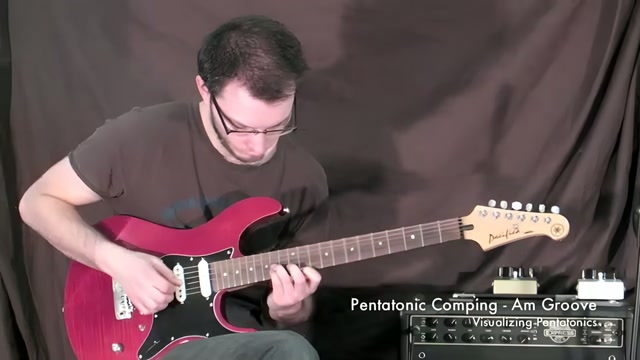
Let's take this comping idea and apply it to a static groove. I know one problem many people have when playing over a static groove is knowing how to create interesting chordal ideas which don't just rely on...
-
6
 0:40
Lesson · 1m Visualizing Pentatonics - Comping - Giant Leaps
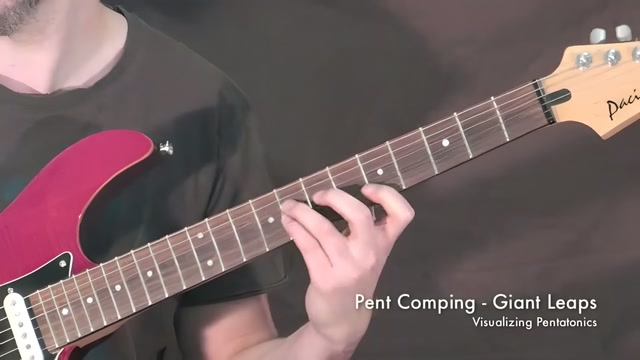
Here's our final comping example using pentatonic scales as our harmonic source. The chord sequence below is from a well known tune by John Coltrane. I'll name this one Giant Leaps! That should give you a...
-
7
 1:17
Lesson · 1m Visualizing Pentatonics - Comping - Roundup
When you apply these ideas to playing chords, you simply need to follow a few simple rules and everything should fall into place. Most fusion and jazz tunes and even some modern funk songs change key often...
-
8
 0:52
Lesson · 1m Visualizing Pentatonics - Line Playing
One of the great things about visualizing the pentatonics is that it allows us to create lines in addition to new comping ideas. Over the next few videos, I'll introduce you to four of the kind of lines I play...
-
9
 0:28
Lesson Visualizing Pentatonics - Line No. 1
Now, on to line playing! All of these examples are TABBED for 4ths tuning but the standard tuned versions are at the end of the tutorial. I recommend you print these out for reference as some of the fingerings...
Tab
-
10
 0:28
Lesson Visualizing Pentatonics - Line No. 2
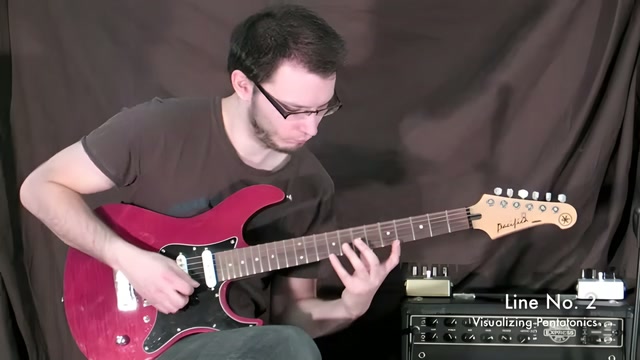
Line No. 2 is a descending 16th note triplet phrase utilizing stretched sus4 arpeggios built from our Am pentatonic again. I've incorporated a sneaky Dsus4 arpeggio at the beginning of the line (this works...
Tab
-
11
 0:25
Lesson Visualizing Pentatonics - Line No. 3
Here is line no. 3, built exclusively from the Am Pentatonic scale. Again, I've used sus4 shapes and their inversions to create the line beginning with a Gsus4 in the 1st inversion, followed by an Asus4 in the...
Tab
-
12
 0:29
Lesson Visualizing Pentatonics - Line No. 4
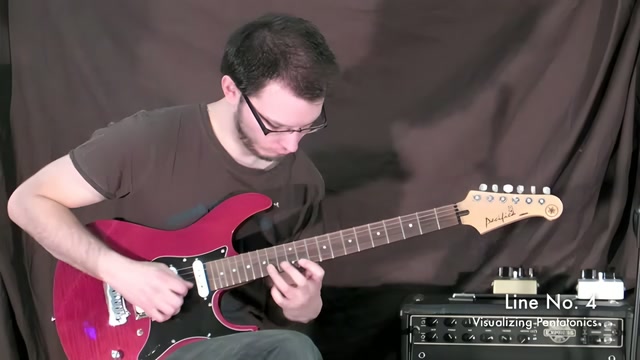
Here is our final line built from the Am pentatonic scale. This example makes the most blatant use of it as far as the sus4 shapes go. If you analyze the line, you'll see that we're simply playing each...
Tab
- 13 1:17 Backing track · 1m Visualizing Pentatonics - Am Groove Backing Track Here's the Am groove backing track. Remember that we're using the two sus4 chords built from the root and b7 of the scale, so in this case: Asus4 and Gsus4 from the Am pentatonic scale. Use these two chords in...
- 14 2:26 Backing track · 2m Visualizing Pentatonics - Giant Leaps Backing Track Here's the backing track for Giant Leaps. By the way, the original version of this tune is at about 280bpm! Guys like Kurt Rosenwinkel use this sus chord technique effortlessly at that tempo. Back to...
- 15 Lesson Visualizing Pentatonics - TABS (Standard Tuning) Here are the TABS in standard tuning for this tutorial. FIrst you'll see the Csus4 inversions, then below you'll find all 4 line playing exercises. Cheers, Tom Tab
More like this
 Playing Over Changes
Tom Quayle
Hi there guys! Welcome to this tutorial on 'Playing Over Changes'. This is the idea of playing or improvising over a series of chords that change key every bar or other bar. We aren't going to be dealing with...
 Modern Legato Application
Tom Quayle
Hi there guys and welcome to this tutorial on Legato and Hybrid picking that I've entitled Modern Legato Application/Approach. In this lesson I'm introducing you to 5 examples of phrases or lines that I often...
 Playing Outside
Tom Quayle
Hi Guys and Gals! Welcome to this months tutorial which is all based on 'outside' playing. Now I'm not suggesting that you all find a nice field somewhere and play in the fresh air. Rather the way in which...
 Playing Over Changes Pt 2
Tom Quayle
Hi there and welcome to part 2 of 'Playing over Changes'. This time we'll be dealing with melodic minor chords and their associated scale choices and also with motivic development over changes. For the purpose...
 Using Melodic Minor Scales
Tom Quayle
Hi Guys! Welcome to this tutorial on using Melodic Minor Scales. In this tutorial we'll be learning how to use melodic minor scales in conjunction with the major scales we already know in a harmonic context...
 Time Feel - Working your Internal Metronome
Tom Quayle
Hi guys! Welcome to this tutorial - a lesson all about developing your internal metronome and time feel. Time in music is without a doubt the most important aspect of your playing. This has been demonstrated...