

The Allure of Thirdless Voicings
Welcome! In this tutorial we're going to take a gander at thirdless voicings and how to use these both to further our own improvisation, but also as practicing tools for ear training, as well as excellent song writing tools! A thirdless voicing is basically just a chord without the third scale degree, for example E in C major (C,E,G), or Eb in Cm (C,Eb,G). A power chord with the root, fifth and octave can be said to be the simplest form of a thirdless voicings, and very well used at that! However, there are myriads of other examples of thirdless voicings to be discovered. One other common voicing would the the sus7. For example Csus7 would then be 1,4,5,b7 (often played in the voicing of C, G, Bb, F "A-form"). You will find this chord often resolving back to the C7 (check out every other Beatles song, these voicings are plentiful). However, one important issue that we also need to cover is how we perceive these chords when in the larger context of a key and song. In the video I have used some of the chords I used in my Vibrato and Timing tutorial. In this case however, we will focus on the actual voicings themselves. Our ears (at least those of us grown up with western style 12-tone music) are conditioned from an early age to recognize the relationships between chords in a given key, and almost to expect certain voicings and functions, such as say the V-chord being a dominant, resolving to the I-chord. When you listen to the chords in the video, I think that most of you will hear the voicings as minor, major, major. That is, Am, F, and G. What we're really hearing though is an Amin7(no5), Fsus2 (with the fifth and ninth displaced one octave), and a G5 (same here). The Fsus2 and G5 in and by themselves have no inherent major or minor quality to them. But, when played in conjunction with the Am7, setting the key of the progression, our minds "fill in the blanks", and tells us to perceive them as major chords, rather than minor. Listen to video and you will hear what I mean. So once we have become better acquainted with this function of our minds, let's move on to an exercise to help us govern our perception, and deepen our listening skills!
6 Lessons
-
1
 8:10
Lesson · 8m Thirdless Voicings - Part 1
Welcome! In this tutorial we're going to take a gander at thirdless voicings and how to use these both to further our own improvisation, but also as practicing tools for ear training, as well as excellent song...
Tab
-
2
 5:29
Lesson · 5m Thirdless Voicings - Part 2
So, the first thing we want to get in our heads are how the different chord tones sounds in relation to the thirdless voicings. So, I want you to sing as you play the chords the roots (A,F,G), then the fifths...
-
3
 6:11
Lesson · 6m Thirdless Voicings - Part 3
OK, so the concept of thirdless voicings can of course be expanded to cover pretty much any musical style. If you're into fusion, fine. If you're into singing/songwriting, equally fine! This is something that...
-
4
 7:21
Lesson · 7m Thirdless Voicings - Part 4
So, "fusion" then... Fusion is of course a very broad genre, so we will just focus on the kind of modern fusion that leans heavily towards quartal harmony and such. In the first part, with the progression...
Tab
-
5
 1:34
Lesson · 2m Thirdless Voicings - Outro Improvisation
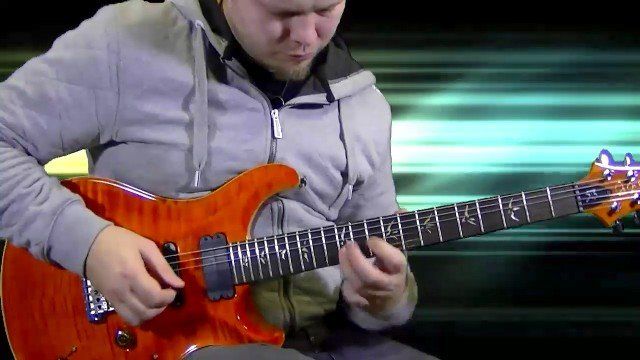
And here is the impro. Even though I make a conscious effort to work around the thirds we discussed, it's still an improvisation, and as such I don't limit myself to simply that, but go were the moment takes...
- 6 6:24 Backing track · 6m Thirdless Voicings - Backing Track OK guys, here is the backing track I used for the outro improvisation. What I've done is just loop it four times, so you can improvise over it, going back and forth over the first and second voicings. Tab
More like this
 Playing Over Changes
Tom Quayle
Hi there guys! Welcome to this tutorial on 'Playing Over Changes'. This is the idea of playing or improvising over a series of chords that change key every bar or other bar. We aren't going to be dealing with...
 Visualizing Pentatonics
Tom Quayle
Hi there guys! Welcome to this tutorial on visualizing pentatonic scales for guitar. This tutorial aims to help you break out of the rut that the typical box pattern approach to learning pentatonics can...
 Modern Legato Application
Tom Quayle
Hi there guys and welcome to this tutorial on Legato and Hybrid picking that I've entitled Modern Legato Application/Approach. In this lesson I'm introducing you to 5 examples of phrases or lines that I often...
 Playing Outside
Tom Quayle
Hi Guys and Gals! Welcome to this months tutorial which is all based on 'outside' playing. Now I'm not suggesting that you all find a nice field somewhere and play in the fresh air. Rather the way in which...
 Playing Over Changes Pt 2
Tom Quayle
Hi there and welcome to part 2 of 'Playing over Changes'. This time we'll be dealing with melodic minor chords and their associated scale choices and also with motivic development over changes. For the purpose...
 Using Melodic Minor Scales
Tom Quayle
Hi Guys! Welcome to this tutorial on using Melodic Minor Scales. In this tutorial we'll be learning how to use melodic minor scales in conjunction with the major scales we already know in a harmonic context...