


C# standard is what happens when E standard stops feeling heavy enough, and you’re not ready to buy a seven-string 😅 Every string goes down three frets, the riffs get darker, the strings get floppier, and suddenly your power chords sound like they owe somebody money.
Here are the notes, how to get there with our free tuner, which strings keep it from turning into spaghetti, how it compares to Drop C# and C standard, the bands that live there, and which of our lessons to play once you’re down there.
The notes in C# standard tuning
From the low (thickest) string to the high one, C# standard is:
C# F# B E G# C#
Every string drops a step and a half, which is three frets. E becomes C#, A becomes F#, D becomes B, G becomes E, B becomes G#, and the high E becomes C#. Because all six strings move by the same amount, the spacing between them doesn’t change. Every chord shape, scale pattern and riff you already know works exactly the same way. It just comes out three frets lower.
You’ll also see it called Db standard or “step and a half down.” Same tuning, different spelling. C# and Db are the same note wearing different hats.
Quick sanity check: an open E shape played in C# standard comes out as a C# chord. Want a real E? Move the shape up to the 3rd fret.
How to tune to C# standard with our tuner
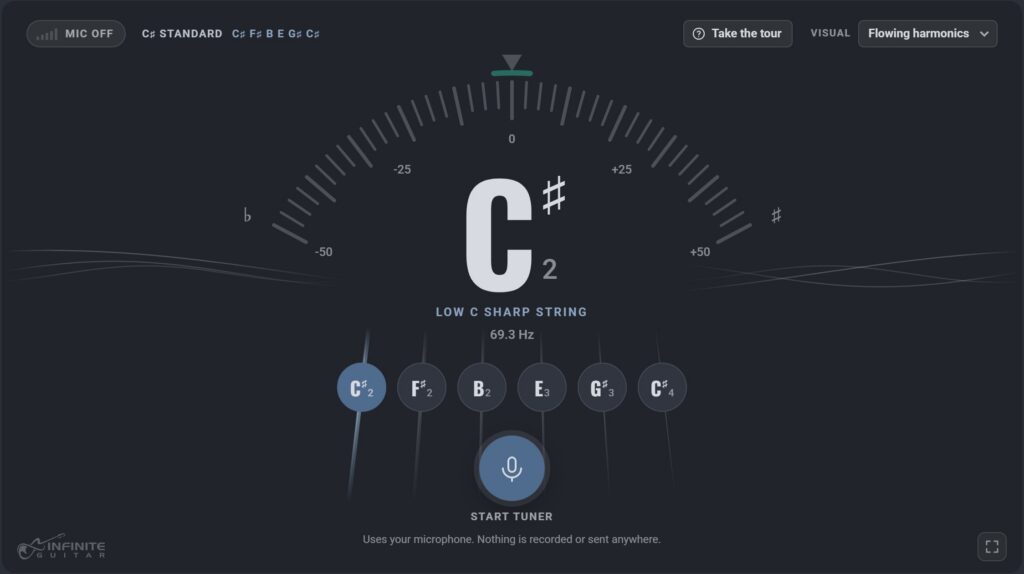
Open our C# standard tuner. It’s already set to C# F# B E G# C#, so all you do is hit Start tuner, allow the microphone and play each string. Nothing is recorded or sent anywhere, it only listens.
Two settings make the trip down a lot less annoying:
- Detect string: Manual. When you drop a string three frets, it spends a while in the wrong zone and auto detection can guess the wrong string. Switch to Manual, tap the string you’re tuning, and the tuner only listens for that one.
- Pitch. The pitch control moves every string down a half step at a time. Three clicks down from standard and you’re in C# standard, which is handy if you want to start from our main guitar tuner instead.
Expect to tune twice. Dropping that much tension lets the neck relax, so the first strings drift while you do the rest. Go around again. Then maybe once more, because guitars are like that.
What string gauge for C# standard?
This is where most people’s first attempt goes wrong. Tune a set of 9s or 10s down three frets and the low string flaps around like a jump rope. It buzzes, it goes sharp every time you pick it hard, and the intonation goes out the window.
Heavier strings fix it. guitarguitar’s tuning guide suggests 11-54 as a starting point for C# standard, and their C# tuning article recommends 11s on 25.5″ scale guitars and 12s on 24.75″ scale guitars. That’s because a shorter scale holds less tension at the same pitch, so it needs a little more string to feel tight. Starting points, not laws. Like it slinky? Go lighter. Dig in hard? Go heavier.
Richard Lundmark explains the trade-off in Bending Boot Camp: String Gauge and Exercises: tuned to the same pitch, a thicker string has more tension and is harder to bend. Down in C# standard the lower pitch takes most of that extra tension back, so thicker strings still bend like normal.
After a gauge jump, plan on a quick setup. The nut slots may need widening so the thicker strings don’t catch, and the intonation almost always needs a tweak. Mike Salow covers the basics in Guitar Setup and Cleaning: Restringing and Intonating, Part 1, where a different gauge and a different tuning are the first two things on his list of what throws intonation off.
C# standard vs Drop C# vs C standard
These three get mixed up all the time, so here’s the short version:
- C# standard: C# F# B E G# C#. Every string down three frets. Same shapes as standard, lower pitch.
- Drop C#: C# G# C# F# A# D#. Everything down a half step, then the low string down another whole step. Power chords become one finger across the bottom three strings, but the top five strings sit two frets higher than in C# standard.
- C standard: C F Bb Eb G C. One more fret down from C# standard. Even heavier, even floppier, and you’ll want 12s or more.
And one more worth knowing: drop the low C# a whole step to B and you get Drop B, B F# B E G# C#. It’s C# standard with a dropped low string, the same way Drop D is E standard with a dropped low string. That makes C# standard a great home base: one string change and you’re in one of metal’s most popular drop tunings.
The bands that live in C# standard
Black Sabbath
Tony Iommi is the reason a lot of people tune this low at all. After a factory accident took the tips off two of his fretting-hand fingers, Iommi tuned down three semitones on Master of Reality (1971) to take tension off the strings and make playing hurt less. Wikipedia lists “Children of the Grave”, “Lord of This World” and “Into the Void” as the songs he tuned down for. The side effect was a sound so heavy it basically invented a genre. Iommi has said that once they tuned down, Ozzy simply started singing higher. Rock and roll problem solving.

Down
Down tuned to C# standard from their debut NOLA in 1995, and later added B standard and drop A, still on six-string guitars. If you want to hear what C# standard sounds like with a big swampy groove behind it, that record is the one.
Behemoth
The Polish extreme metal band has moved between a few tunings over the years, but C# standard is the one they come back to most, including on The Satanist.
Decapitated
Decapitated started out in D standard and moved down to C# standard a few albums in, with The Negation and then Organic Hallucinosis. They’ve since added Drop B, which, as you now know, is just C# standard with the low string dropped.
Sleater-Kinney
Proof it’s not only a metal thing. Carrie Brownstein told Guitar World, “We tune to C#, which creates sourness,” and said most players wouldn’t want to live there. For them, that slightly off feel is exactly the point.
Our lessons to play in C# standard
Here’s the nice part about a standard-shaped tuning: every lesson in our library that’s taught in standard tuning works in C# standard with the exact same frets and fingerings. You just sound heavier. That includes everything you’ll find in our chord chart and scale chart. Fair warning, though: you’ll sound three frets lower than the lesson video, so tune back up if you want to play along in the same key.
A few lessons fit this tuning especially well:
- Lucas Fowler’s Drop B Tuning Etude. Lucas plays it in standard with only the low string dropped to B, for that seven-string growl on a six-string. At the end of Riff 3 he suggests moving the whole tuning shape down a half step, a whole step or a step and a half for even lower, more modern metal sounds. Take the step and a half option and your top five strings are in C# standard.
- Mike Salow’s Drop Tuned Chord Voicings and Drop Tuned Triads. Mike says outright that these voicings work in any drop tuning, so drop your C# string to B and they’re ready to go in Drop B.
- Chris Feener’s Drilling Drop D and Riff like Lamb of God. Both are taught in Drop D. Drop D shapes are Drop B shapes, so from C# standard, drop the low string a whole step and every riff carries over, just a lot lower.

Want more? Our alternate tunings lessons cover drop, open and custom tunings, and the muting lessons will help a lot, because low tunings ring out more than you’d expect and tight palm muting is what keeps them from turning into mud.
Quick recap
- C# standard is C# F# B E G# C#, every string three frets down.
- All your shapes stay the same.
- Go up in gauge: around 11-54 is a good start, heavier on shorter scale guitars.
- Tune twice, then check your intonation.
- Drop the low string to B and you’re in Drop B.
Now go make your neighbors wonder what’s wrong with their speakers. See you on the fretboard!
Opens in a new tab